Porcelain Pavers vs Concrete: Which Is Ideal for Your Project?
 Ducon Outdoor Living
Concrete Pavers vs Porcelain: Why Concrete Wins for Most Homeowners
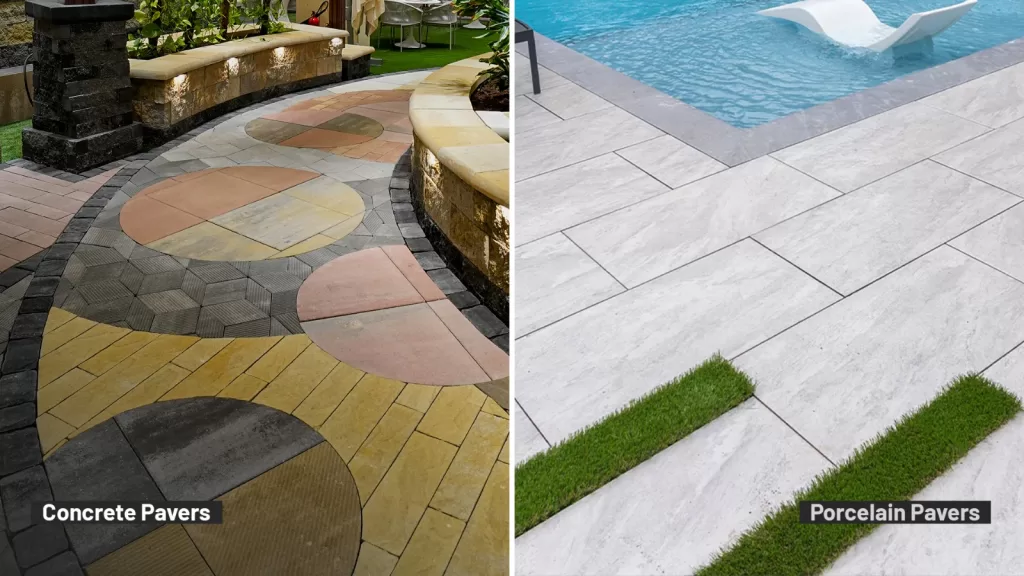
Let’s cut through the marketing noise and talk numbers. When you’re comparing concrete pavers vs porcelain pavers, most contractors will quote you the material cost and installation fee. What they won’t tell you is what happens after three years.
What are concrete pavers and porcelain pavers?
- Concrete pavers, are constructed of concrete and sand, and they harden naturally once molded into shape.
- Porcelain pavers on the other hand, are created by combining clay, sand, and other ingredients, then baking them to achieve their final shape.
Concrete pavers are less expensive and more durable than porcelain pavers, making them a better option for consumers looking to save money on premium pavers for their outdoor. They’re also relatively simple to build and install, making them a popular choice for homeowners.
How do concrete pavers and porcelain tiles perform in extreme weather conditions?
This is where concrete pavers really shine, and it’s something most comparison articles completely ignore. While porcelain tiles look impressive in controlled environments, they face serious challenges when mother nature decides to test them.
- Freezing and heating cycles are harsh on any outdoor material, but concrete pavers withstand them better than many people assume.
Quality outdoor concrete tiles use precise aggregate mixtures that allow for thermal expansion without cracking. They are permeable enough to minimize water collection while remaining strong enough to withstand freezing damage.
- Heat performance is another area where concrete takes the lead.
In regions with intense summer sun, porcelain tiles can become uncomfortably hot to walk on barefoot. Some types actually retain heat well into the evening hours. Concrete pavers, especially lighter colored varieties, reflect more heat and cool down faster as temperatures drop.
- The true issue is how it hits resistance.
Placing a large planter on porcelain paver will most likely result in breaking. Concrete pavers can withstand the same force without any damage. This is more important than most homeowners believe
- Rain performance deserves special mention too.
Many concrete paver systems are designed as permeable concrete pavers, allowing water to drain through the joints and reduce runoff issues. This not only prevents standing water but can actually help with local drainage problems that plague many outdoors.
What maintenance differences should you expect with concrete pavers vs porcelain tiles?
Maintenance is where many homeowners get surprised, and it’s an area where concrete pavers offer significant advantages that most comparison guides completely miss.
- Cleaning concrete pavers is straightforward and uses common household products. A pressure washer, and occasional sand replacement in joints handles most maintenance needs. After a few years, restoration and resurfacing by Ducon can make it look just like new.
- Porcelain tiles sound low-maintenance in theory, but the reality is more complex. While the surface resists staining, the grout lines between tiles become magnets for dirt, algae, and discoloration. Cleaning grout effectively requires specific products and techniques, and even then, it often needs periodic professional cleaning to maintain its appearance.
- Joint maintenance reveals another concrete advantage.
Sand joints in concrete paver installations are meant to be maintained and refreshed periodically. This isn’t a design flaw, it’s a feature. Fresh joint sand keeps the installation stable while allowing for easy adjustments if settling occurs.
- Porcelain tile grout, once it starts failing, requires complete removal and replacement. This is a process that often disturbs surrounding tiles.
How do design options compare between concrete pavers vs porcelain tiles?
This might surprise you, but concrete pavers actually offer more practical design flexibility than most porcelain options, especially when you consider long-term satisfaction and adaptability.
- Texture options in concrete are practically unlimited. From pinstripes, mondrian, flat, rive, waves, travertine to collage, we have boundless textures. Many decorative walkway pavers incorporate multiple textures within the same product line for enhanced design flexibility.
- Pattern possibilities really showcase concrete’s advantages.
Modular paving systems allow for complex geometric designs, curved installations, and even mixed-size patterns that create visual interest.
- Size variety gives concrete pavers another edge. From small, intricate patterns that create clean, contemporary lines, concrete offers options for every design preference. This variety also makes it easier to work around obstacles, utilities, or irregular spaces.
Which material handles heavy loads better: concrete pavers vs porcelain tiles?
When it comes to load-bearing capacity, concrete pavers demonstrate clear superiority, especially in applications that go beyond basic foot traffic. This is crucial information that most comparison articles ignore completely.
- Heavy-duty paver installation using concrete can easily handle vehicle traffic, delivery trucks, and even emergency vehicle access when properly installed.
- Many driveway paving stones are specifically designed for vehicle loads, with high compressive strengths. This makes them suitable for driveways, commercial applications, and high-traffic areas.
- Porcelain tiles, despite their hardness, are fundamentally breakable materials. They can handle distributed loads reasonably well, but point loads or impact forces often cause cracking or chipping. This limitation makes them less suitable for areas where heavy objects might be dropped or wheeled across the surface.
| Factor | Concrete Pavers | Porcelain Tiles |
| Heavy Load Capacity | High compressive strength, handles vehicles | Break under point loads, foot traffic only |
| Weather Resistance | Excellent freeze-heating performance, heat reflective | Prone to thermal shock, retains heat |
| Maintenance Cost | Comparatively less | High maintenance cost |
| Repair Difficulty | Individual replacement in under 1 hour | Requires removal of whole set and re-installation |
| Color Matching | Weathers naturally to blend | Permanent finish makes replacements obvious |
| Pattern Flexibility | Unlimited options, changeable | Limited to initial installation |
| Environmental Impact | Sustainable product from Ducon | Mostly Imported |
| Slip Resistance | Maintains texture naturally | Can become slippery when wet |
| Vehicle Access | Handles equipment and delivery trucks | Requires protective measures |
| Joint Maintenance | Simple sand refresh | Complex grout replacement |
| Lifespan | 20-30 years with maintenance | 10-20 years in ideal conditions |
| Replacement Availability | Readily available at Ducon | Have to wait as the whole set should be replaced |
| Long-term Value | Excellent ROI, adaptable | Higher costs, limited flexibility |
Quick Decision Guide: Which Should You Choose?
Choose Concrete Pavers from Ducon If:
- You want proven durability and performance
- Premium pavers for affordable price is a primary consideration
- You need vehicle or equipment access
- Easy maintenance and repairs matter
- You live in areas with temperature extremes
- Long-term value is important
Choose Porcelain Tiles If:
- Initial appearance is your top priority
- You have unlimited budget for installation and maintenance
- The area will only see light foot traffic
- Professional installation and maintenance are preferred
- You’re in a controlled climate environment
The evidence clearly supports concrete pavers from Ducon Outdoor Living as the superior choice for most homeowners seeking durable, attractive, and cost-effective outdoor flooring solutions.
While porcelain tiles have their place in certain applications, concrete pavers deliver better overall value through lower costs, easier maintenance, superior durability, and greater design flexibility. When you’re investing in your home’s outdoor spaces, concrete pavers from Ducon provide the reliability and performance that real families need for years of satisfaction and enjoyment.
Let’s Start Designing your Patio !
Still Have Questions ?
Talk with our experts for Plan, design and implementation.
Are there design differences between the Concrete and Porcelain Pavers ?
Both concrete and porcelain pavers provide a diverse range of design options in terms of color, form, and pattern. Some may prefer the natural stone look commonly attained with porcelain pavers, but concrete pavers can replicate a range of materials, including brick and genuine stone.
Can both concrete and porcelain types of pavers be utilized in different outdoor applications?
Yes, however most concrete pavers are suitable for a variety of outside applications, including patios, walks, driveways, and pool decks. The choice, however, may be determined by individual project requirements and aesthetic preferences.